Solutions
A solution is a homogeneous mixture of two or more components. The dissolving agent is the solvent. The substance which is dissolved is the solute. The components of a solution are atoms, ions, or molecules, which makes them 10-9 m or smaller in diameter.
Example: Sugar and Water
Suspensions
The particles in suspensions are larger than those found in solutions. Components of a suspension can be evenly distributed by a mechanical means, like by shaking the contents, but the components will settle out.
Example: Oil and Water
Colloids
Particles intermediate in size between those found in solutions and suspensions can be mixed such that they remain evenly distributed without settling out. These particles range in size from 10-8 to 10-6 m in size and are termed colloidal particles or colloids. The mixture they form is called a colloidal dispersion. A colloidal dispersion consists of colloids in a dispersing medium.
Example: Milk
More Dispersions
Liquids, solids, and gases all may be mixed to form colloidal dispersions.
Aerosols: solid or liquid particles in a gas.
Examples: Smoke is a solid in a gas. Fog is a liquid in a gas.
Sols: solid particles in a liquid.
Example: Milk of Magnesia is a sol with solid magnesium hydroxide in water.
Emulsions: liquid particles in liquid.
Example: Mayonnaise is oil in water.
Gels: liquids in solid.
Examples: gelatin is protein in water. Quicksand is sand in water.
Telling Them Apart
You can tell suspensions from colloids and solutions because the components of suspensions will eventually separate. Colloids can be distinguished from solutions using the Tyndall effect. A beam of light passing through a true solution, such as air, is not visible. Light passing through a colloidal dispersion, such as smoky or foggy air, will be reflected by the larger particles and the light beam will be visible.
Footnotes:
Homogeneous solution - solution in which solute particles are dissolved completely and solutes are not seen with naked eyes. Example is salty water, sugar dissolved in water, etc.
Heterogeneous solution - solution in which solute particles are not completely dissolved and are seen clearly are called heterogeneous solutions. For example, sand in water, milk in water, etc.
Heterogeneous solution are divided into two parts:
1. Suspension : Big solute particles
2. Colloid : Small solute particles
Done with Reference from: http://chemistry.about.com
Thursday, 23 September 2010

Topic: Mixtures, Solutions and Suspensions - The Basics
Mixtures
A mixture is a combination of substances which are not chemically joined together.
Mixtures have the same properties as their components
There is no fixed proportion between the components
The components can be separated from the mixture
Examples
sugar and salt
air with nitrogen, oxygen
Solutions
A solution is a mixture in which other substances (solutes) are dissolved.
The components in a solution may not be separated from the solution by leaving it to stand, or by filtration
If a material dissolves in a liquid the material is said to be soluble. A solution is saturated if no more solute can be dissolved with temperature remaining constant.
Examples
salt in sea water
Suspensions
A suspension is a mixture of liquids with particles of a solid which may not dissolve in the liquid.
The solid may be separated from the liquid by leaving it to stand, or by filtration
Examples
sand in water
Good To Know
There are three types of solutions. Isotonic solutions, Hypotonic solutions and Hypertonic solutions. Each type of solution have different chemical properties.First one is Isotonic Solutions. Isotonic solution are those solutions, which have the same osmotic pressure, 0.9% NaCl is isosmotic with the human blood plasma.If human red blood cells are placed in this solution, they remain intact and retain their original shape and volume.
0.9% NaCl is therefore isotonic as well as isosmotic with red blood cell because the amount of water entering ht cells is equal to that leaving them and there is no net gain or loss of water by the cells.
The solutions which are less concentrated than 0.9% NaCl are called hypotonic solutions.
If human red blood cells are placed in this solution, the water will enter the cell making them swollen and if the solution is very dilute the cells will rupture releasing their HB in the solution (hemolysis).
Third and the last ones are Hypertonic Solutions. The solutions which are more concentrated than 0.9% NaCl are called hypertonic solutions. If the human red blood cells are placed in this solution, the water will leave the cells and the cells shrink.
From: Google Search Engine
According to the chemical classification of matter there are two main categories:
Pure substances
Mixtures
Lavoisier, a French chemist on the basis of quantitative studies classified pure substances into elements and compounds. He showed that when we heat mercuric oxide it changes into mercury and oxygen.
Mercuric oxide is a compound because it decomposes into simpler substances, whereas mercury and oxygen cannot be further decomposed into anything simpler as they are elements.
Element
It is defined as a substance that cannot be further reduced to simpler substances by ordinary processes. Elements are made up of particles/atoms of only one kind.
For example: Hydrogen and oxygen
There are 114 elements known. Out of these 92 of them occur in nature.
Metals and non-metals
Elements can be further divided into metals and non-metals.
Metals
They are generally solids with characteristics such as hardness, malleability, ductility high tensile strength, lustre and ability to conduct heat and electricity.
For example: Copper, iron, zinc etc.
Non-metals
They are generally non-lustrous, brittle, poor conductors of heat and electricity.
For example: Sulphur, phosphorus, nitrogen etc.
Metalloids
These elements have characteristics common to metals and non-metals.
For example: Arsenic, tin, bismuth etc.
Compound
It is a pure substance that can be decomposed into simpler substances by some suitable chemical technique. A compound is formed by combination of two or more elements in a definite proportion.
For example, water is a compound of hydrogen and oxygen elements present in the ratio of 1: 8.
Properties of compounds
A compound cannot be separated into its constituents by mechanical or physical means.
For example, if we bring a magnet near a sample of iron sulphide, the iron present in the iron sulphide cannot be separated.
Properties of a compound differ entirely from those of its constituent elements.
For example, water is made up of hydrogen and oxygen. However, the properties of hydrogen and oxygen (both gases) are different from water (liquid). Hydrogen is combustible, oxygen is a supporter of combustion whereas water (made up of both hydrogen and oxygen) puts out a flame.
Energy changes are involved in the formation of a compound. For example, iron and sulphur reacts only when heat is supplied.
The constituent elements in a compound are in a fixed proportion by weight. In water, hydrogen and oxygen are present in a fixed ratio of 1:8 by weight.
A compound is a homogenous substance. That is it is same throughout in properties and composition.
A compound has a fixed melting point and boiling point. For example, ice melts at 0oC.
Mixture
A mixture is a material containing two or more elements or compounds that are in close contact and are mixed in any proportion. The components of a mixture can be separated by physical means.
For example, air, gun powder, etc.
Properties of a mixture
A mixture may be homogenous or heterogeneous. A homogenous mixture has a uniform composition throughout its mass. For example, sugar or salt dissolved in water, alcohol in water, etc. A heterogeneous mixture does not have a uniform composition throughout its mass. There are visible sharp boundaries.
For example: Oil and water, salt and sand, etc.
The constituents of a mixture can be separated by physical means like filtration, evaporation, sublimation and magnetic separation.
In the preparation of a mixture, energy is neither evolved nor absorbed.
A mixture has no definite melting and boiling point.
The constituents of a mixture retain their original set of properties. For example, sulphur dissolves in carbon disulphide and a magnet attracts iron filings.
Types of mixtures
Matter Mixture type Example
Solid Solid mixture Iron filings and sulphur
Solid Liquid mixture Common salt and water
Solid Gas mixture Air entrapped in soil
Liquid Gas mixture Oxygen dissolved in water
Gas Gas mixture Air containing hydrogen, oxygen, nitrogen, carbon dioxide etc.
Liquid Liquid mixture Water and alcohol
Differences between mixtures and compounds
Mixtures Compounds
A mixture can be separated into its constituents by physical processes (filtration, evaporation, sublimation, distillation) A compound cannot be separated into its constituents by physical processes. It can be separated by chemical means
A mixture shows the properties of its constituents A compound has a new set of properties different from its constituents
Composition of a mixture varies and the constituents are present in any proportion by weight. It does not have a definite formula The composition of a compound is fixed and the constituents are present in fixed proportions by weight. It has a definite formula
The constituents do not react chemically, thus no energy changes take place Chemical reactions take place and energy changes in the form of heat and light are involved
A mixture does not have a fixed melting point and boiling point Examples: air, sand and salt A compound has a fixed melting point and boiling point Examples: H2O (water), FeS (iron sulphide)
Water is a compound and not a mixture
The components hydrogen and oxygen cannot be separated by physical methods such as filtration, evaporation.
Hydrogen and oxygen are present in a fixed proportion of 1: 8.
Energy changes accompany the formation of a compound i.e., heat and light are given out.
Properties of water are entirely different from the constituents, hydrogen and oxygen.
The boiling point of water is 100oC at 76 cm Hg i.e., one atmospheric pressure.
Did You Know:
Is salt a compound or mixture?
Salt is the compound sodium chloride, a pure substance.
Something to think about:
Is water (H20) an element, compound, or mixture?


Topic: Aerobic and Anaerobic Respiration
Respiration is one of the imperative functions of the body that are of crucial importance for all the living organisms be it human being, or the microscopic bacteria. In general the process of respiration serves two basic purposes in living organisms, the first one being disposal of electrons generated during catabolism and the second one being production of ATP. The respiration machinery is located in cell membranes of prokaryotes whereas it is placed in the inner membranes of mitochondria for eukaryotes. Respiration requires a terminal electron acceptor. Simply put, the respiration process, which uses oxygen as its terminal electron acceptor, is called aerobic respiration and the one, which uses terminal electron acceptors other than oxygen, is called anaerobic respiration.
Differences between Aerobic and Anaerobic Respiration
Starting from the bio-chemical pathway used to utilize bio-molecules, to the amount of energy produced in the respiration process, there exist a lot of differences between aerobic and anaerobic respiration. Let us discuss the two respiration processes separately with respect to the process, outcome and the chemical reactions involved in aerobic and anaerobic respiration.
Aerobic Respiration
Aerobic respiration is the process that takes place in presence of oxygen. Aerobic respiration is the metabolic process that involves break down of fuel molecules to obtain bio-chemical energy and has oxygen as the terminal electron acceptor. Fuel molecules commonly used by cells in aerobic respiration are glucose, amino acids and fatty acids.. The process of obtaining energy in aerobic respiration can be represented in the following equation:
Glucose + Oxygen →Energy + Carbon dioxide + Water
The aerobic respiration is a high energy yielding process. During the process of aerobic respiration as many as 38 molecules of ATP are produced for every molecule of glucose that is utilized. Thus aerobic respiration process breaks down a single glucose molecule to yield 38 units of the energy storing ATP molecules.
Anaerobic respiration
The term anaerobic means without air and hence anaerobic respiration refers to the special type of respiration, which takes place without oxygen. Anaerobic respiration is the process of oxidation of molecules in the absence of oxygen, which results in production of energy in the form of ATP or adenosine tri-phosphate. Anaerobic respiration is synonymous with fermentation especially when the glycolytic pathway of energy production is functional in a particular cell. The process of anaerobic respiration for production of energy can occur in either of the ways represented below:
Glucose (Broken down to) →Energy (ATP) + Ethanol + Carbon dioxide (CO2)
Glucose (Broken down to) →Energy (ATP) + Lactic acid
The process of anaerobic respiration is relatively less energy yielding as compared to the aerobic respiration process. During the alcoholic fermentation or the anaerobic respiration (represented in the first equation) two molecules of ATP (energy) are produced. for every molecule of glucose used in the reaction. Similarly for the lactate fermentation (represented in the second equation) 2 molecules of ATP are produced for every molecule of glucose used. Thus anaerobic respiration breaks down one glucose molecule to obtain two units of the energy storing ATP molecules.
Done with Reference to Relevant Articles in Google Search Engine
Topic: Pressure
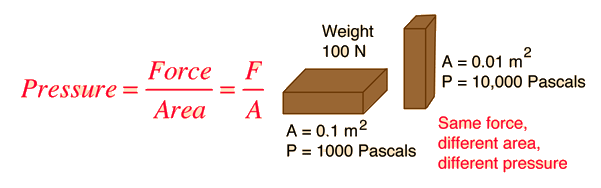
Pressure is defined as force per unit area. It is usually more convenient to use pressure rather than force to describe the influences upon fluid behavior. The standard unit for pressure is the Pascal, which is a Newton per square meter.
For an object sitting on a surface, the force pressing on the surface is the weight of the object, but in different orientations it might have a different area in contact with the surface and therefore exert a different pressure.
Pressure calculation.
There are many physical situations where pressure is the most important variable. If you are peeling an apple, then pressure is the key variable: if the knife is sharp, then the area of contact is small and you can peel with less force exerted on the blade. If you must get an injection, then pressure is the most important variable in getting the needle through your skin: it is better to have a sharp needle than a dull one since the smaller area of contact implies that less force is required to push the needle through the skin.
When you deal with the pressure of a liquid at rest, the medium is treated as a continuous distribution of matter. But when you deal with a gas pressure, it must be approached as an average pressure from molecular collisions with the walls.
Pressure in a fluid can be seen to be a measure of energy per unit volume by means of the definition of work. This energy is related to other forms of fluid energy by theBernoulli equation.


Subscribe to:
Posts (Atom)